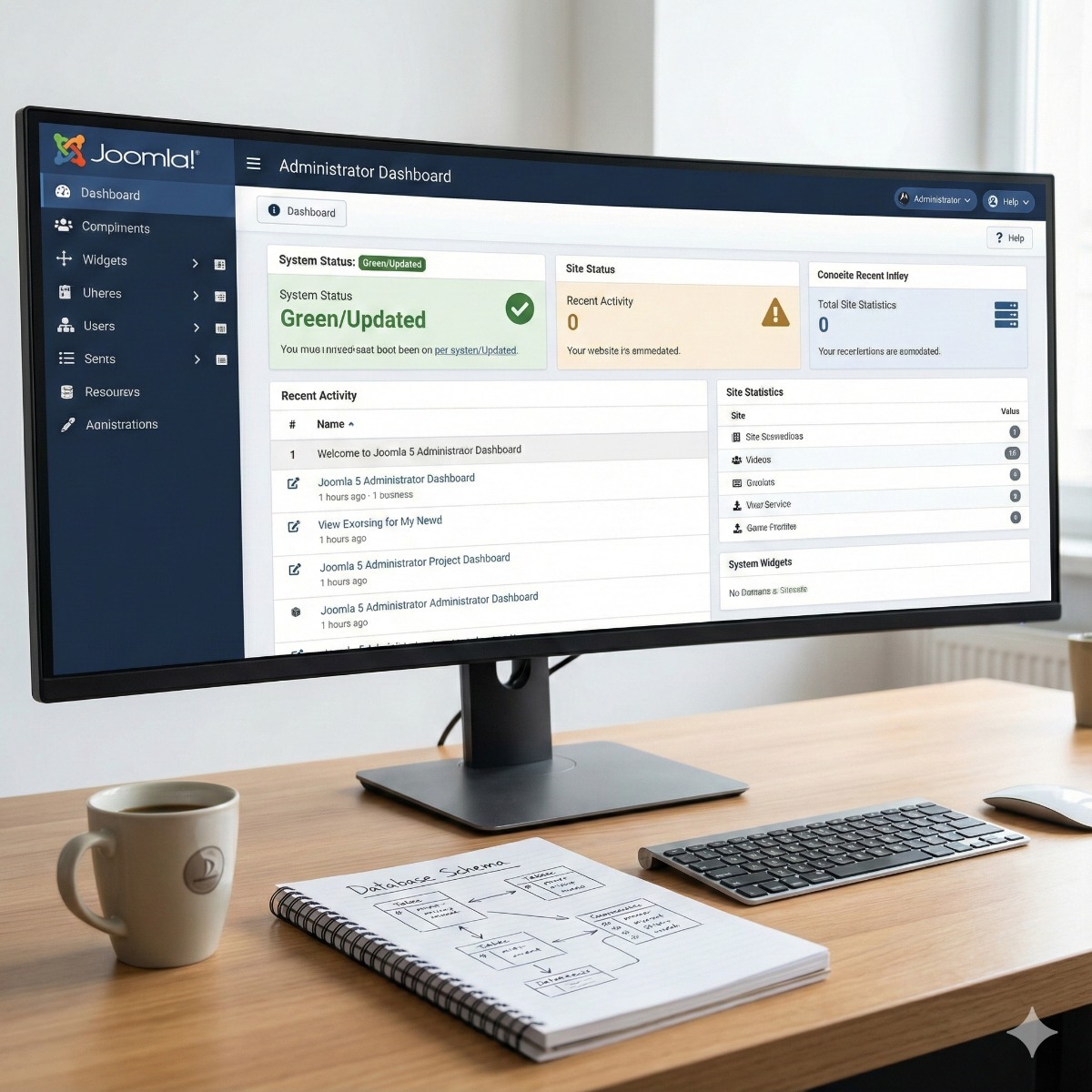



Joomla 4 reached its end of life on October 14, 2025, when security support for the 4.x series ended. Sites on Joomla 4 still load, but new vulnerabilities in the core will not be patched, and extension developers are moving their attention to Joomla 5 and Joomla 6. For a Joomla 4 site the way forward is an upgrade through Joomla 5.4 to Joomla 6. This guide explains what the Joomla 4 end of life means in practice, what the upgrade involves and how to test it without putting the live site at risk.
Joomla 4 end of life: support dates at a glance
Each Joomla major version gets a period of bug fixes followed by a period of security-only support. The dates below come from the Joomla project roadmap and the project's release announcements:
| Version | Bug fixes | Security fixes |
|---|---|---|
| Joomla 3.10 | Ended | Ended August 17, 2023 |
| Joomla 4.4 | Ended October 15, 2024 | Ended October 14, 2025 |
| Joomla 5.4 | Until October 13, 2026 | Until October 12, 2027 |
| Joomla 6 | Until October 17, 2028 | Until October 16, 2029 |
So is Joomla still supported? Yes. Joomla 6, released on October 14, 2025, is the current major version, and Joomla 5.4 keeps receiving security fixes until October 2027. What has ended is Joomla security support for versions 3 and 4.
The upgrade path: Joomla 4 to 5, then 5 to 6
Joomla does not skip major versions. A Joomla 4 site first moves to the latest Joomla 4.4 release, then to Joomla 5, then to the latest Joomla 5.4 release, and only then to Joomla 6. The Joomla 4 to 5 upgrade and the Joomla 5 to 6 upgrade both run through the built-in Joomla Update component, because the database structure and the extension system carry over. The project itself calls the step from 5.4 to 6.0 "an upgrade, not a migration."
Joomla 3 is a different case. Its templates and many of its extensions do not carry over, so a Joomla 3 site needs a real migration with rebuilt parts rather than a click in the administrator. That work is covered by our Joomla 3 to 5 migration service.
Joomla 6 requirements
Check the server before anything else. According to the Joomla manual, Joomla 6 requirements start at PHP 8.3, with PHP 8.4 recommended, and the database must meet the minimum versions the manual lists for MySQL, MariaDB or PostgreSQL. In the administrator, System Information shows what your host runs today. Sites that stayed on Joomla 4 often sit on older PHP as well, so the hosting upgrade and the Joomla upgrade are usually planned together.
Joomla extension compatibility and the pre-update check
Extensions decide how smooth the upgrade will be. Before upgrading, switch the update channel in the Joomla Update options to "Joomla Next" and open the pre-update check. It sorts installed extensions into three groups: those that need an update first, those whose developers have published no compatibility information, and those that report themselves compatible.
Treat the result as a starting point. It relies on developers publishing correct information, and the middle group can only be confirmed by testing or by asking the developer. Joomla extension compatibility is the most common reason an upgrade stalls, especially for paid extensions whose licenses have lapsed or whose developers have stopped working on them.
Joomla also ships backward compatibility plugins to soften each transition. Before moving from Joomla 5 to Joomla 6, the Joomla 5 plugin called Behaviour - Backward Compatibility must be disabled, and its Joomla 6 counterpart, Behaviour - Backward Compatibility 6, takes over. Like its predecessor, it is a bridge for extensions that are still catching up, not a permanent fix. Details are in the official Joomla 5 to 6 planning and upgrade guide.
A Joomla upgrade checklist
- Take a full backup of files and database, and prove it works by restoring it somewhere else.
- Build a staging copy and do every step there first.
- Update all extensions to their latest versions and remove the ones you no longer use.
- Check PHP and database versions against the requirements of the target version.
- Turn on debug mode on the staging copy to surface errors.
- Switch the update channel, review the pre-update check and disable the old backward compatibility plugin.
- Run the upgrade, then test forms, logins, menus, search, the template and any custom components.
- Compare the main URLs with the live site, so nothing that ranks in search starts returning a 404 error.
- Repeat on the live site during a quiet period, with the backup ready.
This Joomla upgrade checklist applies to both steps, from 4 to 5 and from 5 to 6.
Frequently asked questions: joomla 4 end of life
Can we upgrade from Joomla 4 straight to Joomla 6?
No. A site has to run the latest Joomla 5.4 release before it can move to Joomla 6, so a Joomla 4 site goes through Joomla 5 first. Both steps can be rehearsed on the same staging copy.
Should we stop at Joomla 5 or go all the way to Joomla 6?
Joomla 5.4 gives you security fixes until October 2027, which buys time. If all your important extensions already support Joomla 6, doing both steps in one project saves repeating the testing later.
What happens if we stay on Joomla 4?
The site keeps working until something forces a change: a vulnerability that will not be patched, a hosting provider retiring an old PHP version, or an extension that stops working. Planning the upgrade now is far easier than doing it under pressure after a break-in.
Running a Joomla 4 site? Our Joomla development and support page describes how we handle upgrades and ongoing Joomla support, including a classifieds portal of our own that we moved from Joomla 3 to Joomla 5. If the upgrade also means a new server, see our hosting and database migration service. Contact us with your Joomla version, a list of installed extensions and your hosting details.