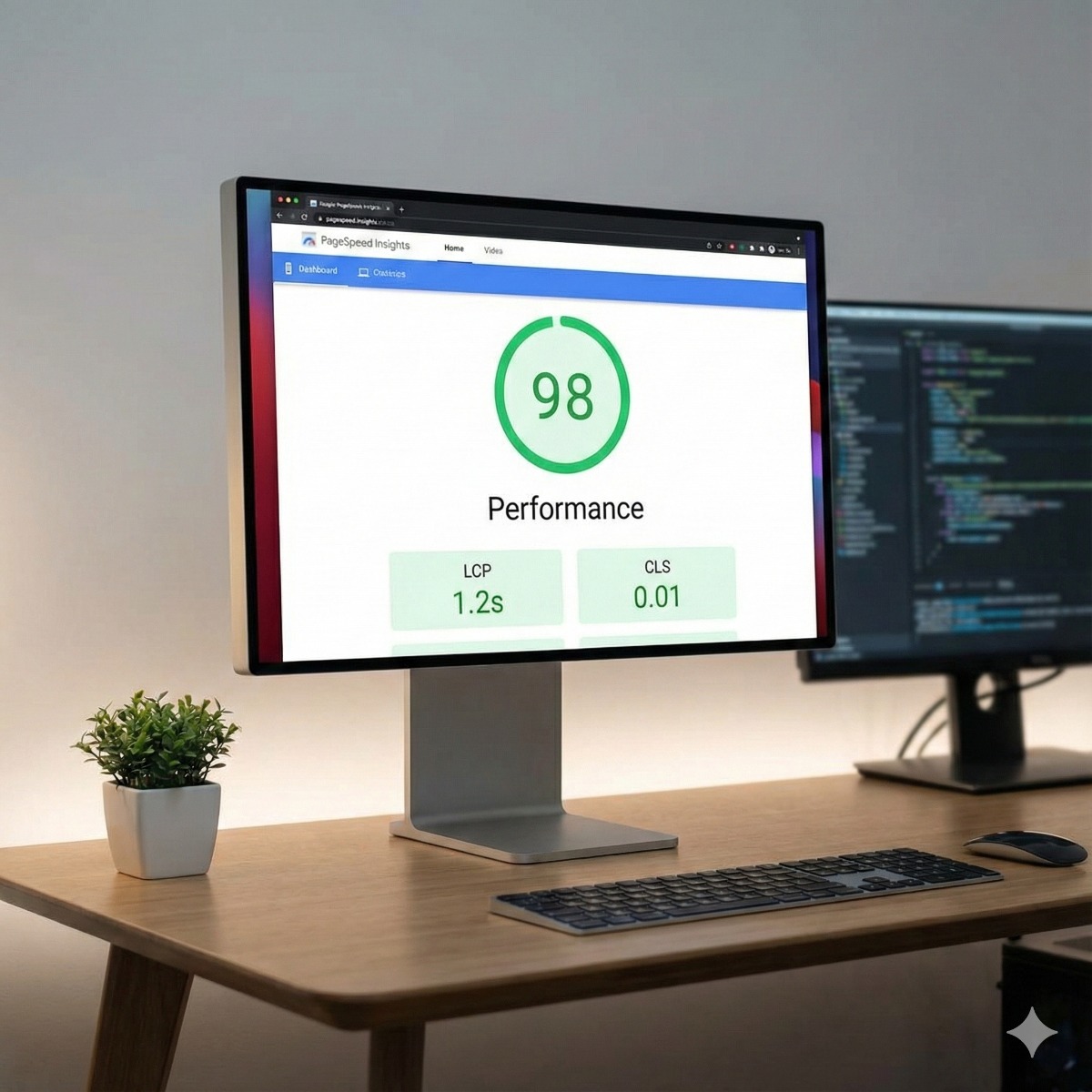





Speed is not a nice-to-have, it is money. Study after study shows that every extra second of load time drives visitors away and drops conversions. On mobile, where patience is shortest, a slow site quietly bleeds sales you never see.
What Core Web Vitals measure
Google’s Core Web Vitals score three things a real visitor feels: how fast the main content loads, how quickly the page responds to interaction, and how stable the layout is while loading. Good scores improve both user experience and search ranking.
How speed affects your bottom line
- Faster pages keep visitors engaged and reduce bounce.
- Higher Core Web Vitals scores support better Google rankings.
- Mobile shoppers, the majority of traffic, convert far better on fast sites.
What actually makes a site fast
Real gains come from optimizing images, caching, and scripts, removing render-blocking code, tuning the database, and improving server response. Many website performance wins do not require new hosting, just proper optimization measured on real devices.
If your site feels sluggish, it is costing you more than patience. Our Core Web Vitals & Performance Tuning delivers measurable before-and-after speed improvements that visitors and Google both reward.
How to measure a slow website properly
Google PageSpeed Insights shows two kinds of data. The field data at the top comes from real Chrome users over the previous 28 days and is what Google uses for Core Web Vitals; the lab score below it is a single simulated test, useful for diagnosis but variable from run to run. A page passes when, at the 75th percentile of visits, it meets all three thresholds:
- Largest Contentful Paint (LCP) of 2.5 seconds or less: how fast the main image or heading appears.
- Interaction to Next Paint (INP) of 200 milliseconds or less: how quickly the page reacts to taps and clicks. INP replaced First Input Delay as a Core Web Vital on March 12, 2024.
- Cumulative Layout Shift (CLS) of 0.1 or less: how much content jumps while loading.
Performance tuning by metric
- Slow LCP: cut server response time with page caching and a current PHP version, serve the hero image in a modern format at the right size, and never lazy-load the main above-the-fold image.
- Poor INP: break up long JavaScript tasks, remove unused plugins and third-party tags, and load chat widgets only when they are needed.
- High CLS: give images and embeds fixed width and height, reserve space for banners, and load web fonts so text does not reflow.
Page speed and conversion rate
The link between speed and revenue has been measured. In the 2020 "Milliseconds Make Millions" study, commissioned by Google and carried out by Deloitte across 37 European and American brand sites, a 0.1-second improvement in mobile site speed was associated with an 8.4% increase in retail conversions. Your results will differ, which is why it pays to measure conversion rate before and after each change.
Frequently asked questions: site speed
Why does my PageSpeed score change every time I test?
Lab tests vary with network conditions, server load and third-party scripts. Judge progress by the field data and by several runs, not a single score.
Do I need a PageSpeed score of 100?
No. Passing the three Core Web Vitals for real visitors matters more than a perfect lab score.
Can better hosting alone fix a slow site?
Faster hosting shortens server response time, but heavy images, scripts and themes still slow the browser down. Most sites need both server and front-end work.
Need help with this? Our Core Web Vitals and performance tuning service measures and fixes all three metrics, Apache web server optimization shortens server response time, and MySQL and MariaDB optimization speeds up slow database queries. Request a quote.