
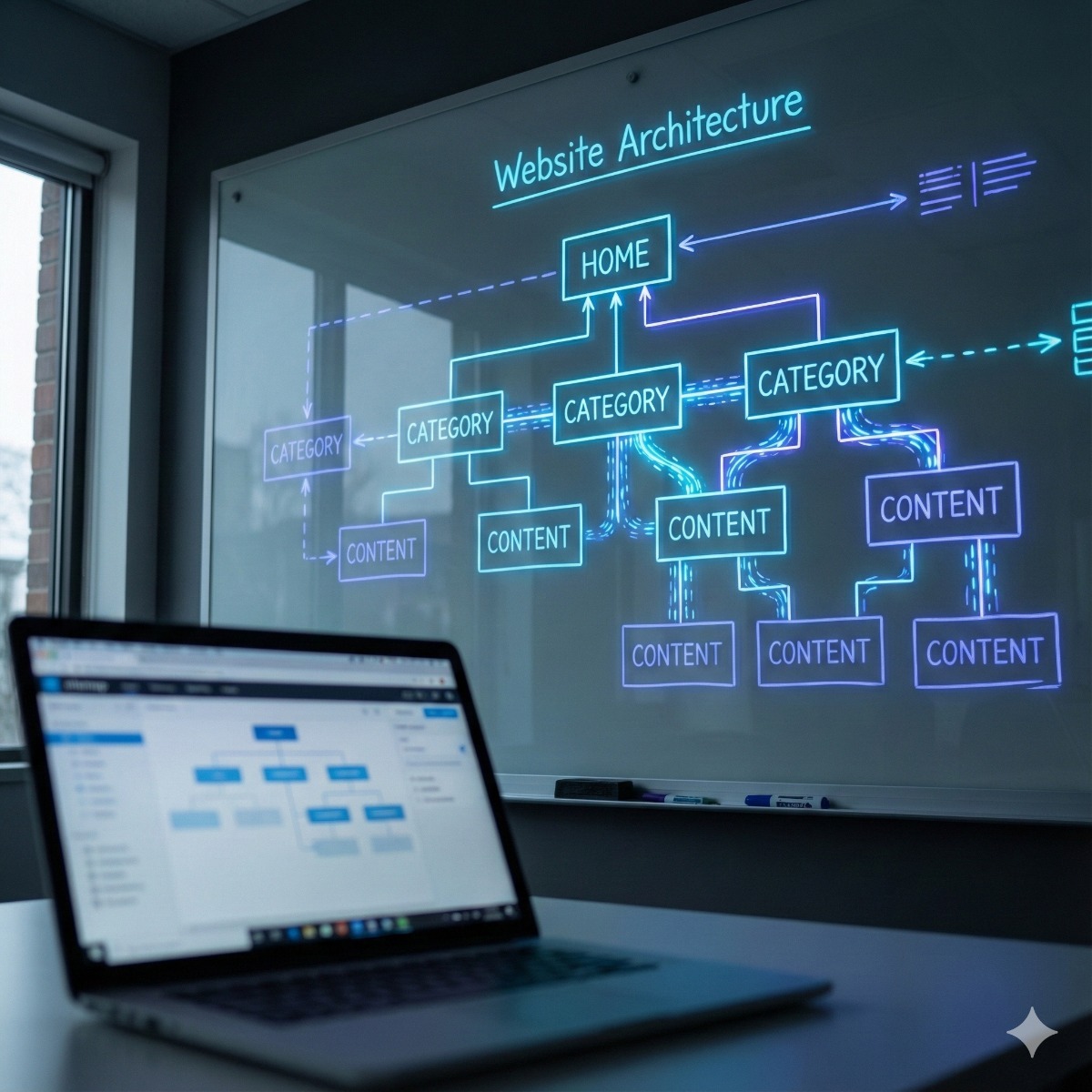
Site Architecture & Internal Linking Strategy
Organize the
Chaos.
If your website is a drawer full of junk, Google won't know what you sell. We rebuild your site's architecture into logical "Silos," connecting related content so that Authority flows from your blog directly to your checkout page.
The "Silo" Method
We group your content into thematic clusters. By strictly linking "Apple Repair" pages only to other "Apple" pages (and not "Samsung" pages), we prove to Google that you are a topical authority in that niche.
Link Juice Flow
Backlinks usually hit your Homepage or Blog posts. Without internal links, that power gets stuck there. We build "bridges" that funnel that ranking power to your "Money Pages" (Service & Product pages).
Fixing Orphan Pages
An "Orphan Page" is a page with zero internal links pointing to it. Google cannot find it. We identify these lost pages and integrate them back into the site structure so they can finally rank.
Architecting Success.
A calculated approach to linking.
Current State Map
We visualize your current site structure. Often, it looks like a spiderweb of random connections. We identify where the "Link Juice" is getting trapped.
Hierarchy Design
We design a "Pyramid" structure. Homepage at the top, Category Pages in the middle, and Product/Blog pages at the bottom. This is the gold standard for SEO.
Contextual Linking
We edit your content to add relevant text links. We use strategic "Anchor Text" (the clickable words) to tell Google exactly what the target page is about.
Navigation UX
We redesign your Main Menu and Footer. We ensure users (and bots) can reach any page on your site within 3 clicks (The "3-Click Rule").
Structural Models.
Proven frameworks we use.



Metrics That Matter.
How we measure structure.
Common Questions
What is "Link Juice"?
It's a slang term for "PageRank." Think of it like water flowing through pipes. If you get a big link from Forbes to your homepage, we use internal links to pipe that "water" to your product pages so they rank too.
Can I have too many links?
Yes. If a page has 500 links, the value passed to each one is tiny (diluted). We prune unnecessary links to ensure the important ones get the most power.
How we audit site architecture for SEO
Site architecture SEO work starts with data rather than opinions. We crawl the whole site the way a search engine does, then compare that crawl with your XML sitemap and with the pages that appear in Google Search Console. The three lists rarely match, and the differences show where the structure is failing.
- Orphan pages. Pages listed in the sitemap or receiving search impressions, yet linked from nowhere on the site. To fix orphan pages we link them from the right category or guide, merge them into a stronger page, or retire them with a redirect.
- Click depth. Important service or product pages buried four or five clicks from the home page, often behind pagination or filters.
- Competing pages. Two or three pages aimed at the same search intent, splitting links and relevance between them.
- Vague anchors. Internal links labeled "click here" or "read more", which tell neither visitors nor search engines what the target page covers.
Information architecture before menus
Information architecture is the plan of what content exists and how it is grouped; the menu is only one way of displaying it. We sort pages by the questions customers actually ask, then decide which pages act as hubs. An SEO hub and spoke layout, with one overview page linking to detailed pages that link back, usually works better than a rigid SEO silo structure. We still group topics into sections, but we allow links between sections wherever a visitor would naturally need them.
What link juice distribution means in practice
The idea is simple: pages that earn external links, often the home page and popular articles, should pass some of that value to the pages that bring in enquiries. In practice that means a few relevant links placed inside the text of those strong pages, not a footer stuffed with keywords. The internal linking strategy we deliver lists the source page, the target page and a suggested anchor text for each new link, so your team can keep it up after we finish.
What we need to start
Access to Search Console and analytics, a short list of the pages that matter most to your business, and a CMS login or a developer contact if navigation templates have to change.
Related services: technical SEO audit and fixes, content updates and optimization and platform migration with redirect mapping.
| Manufacturer | Computer Service Breeze |
|---|








Related Posts
-


 Internal links are the ranking signal you control completely, yet few sites ever check them. This guide shows how to run an internal link audit, what to measure, how to write anchor text and where to...